
‘The coolest times of your life’ – Lamorinda college students reflect on traveling abroad
Ordering food in a foreign language. Navigating unfamiliar streets. Living thousands of miles from home. For three Lamorinda high school graduates, studying abroad transformed these initial uncertainties into some of the most meaningful experiences of their year—and even their lives.
Three recent alumnae of Miramonte High School embarked on immersive academic and cultural experiences abroad, spending anywhere from a quarter to an entire school year in other countries. Leila Maboudian (graduated 2024) spent five weeks in Cholula, a city in Mexico’s Puebla county. Annabelle Ryan (graduated 2025) spent her fall semester in Paris, France. Selma Ahmed (graduated 2024) studied in Rabat, Morocco, for eight months. Each student returned with strengthened language skills, a deeper appreciation for cultural diversity, and memories that will remain long after their time overseas.
For many students, the opportunity to travel abroad arises through a university’s study abroad program. Maboudian, now a sophomore at the University of California, Berkeley, discovered her cultural immersion program at a club fair. “I’ve been thinking about studying abroad for a while, and this offered a lot I was excited about,” Maboudian said. Others, like Ryan, chose to travel abroad during their very first semester of college. A freshman at the University of Southern California, Ryan saw the opportunity to go to France when she opened her acceptance letter. “I learned that I could spend my first semester either at a community college or one of USC’s partner schools abroad,” Ryan said. “I’d never considered studying abroad as a freshman, but I decided to take a leap of faith.”
Ahmed took a gap year to participate in the National Security Language Initiative for Youth (NSLI-Y), a U.S. government program that provides students with full-year cultural immersion experiences. Following her time in Morocco, Ahmed is now attending Stanford University.
Leaving home came with challenges. For any college student, departing from friends and family sparks nervousness – a feeling that is amplified when traveling abroad. Still, every student retained their optimism and curiosity. “I didn’t want to let fear be my driving feeling going into study abroad,” Ryan said.
Once abroad, each student faced unique challenges. In Paris, communication became tough at busy train stations, where few people spoke English. “I’d ask for directions and realize that security guards, and even police, aren’t typically English speakers,” Ryan said. “I saw this early, and I ended up using Google Translate to talk to a lot of people.”
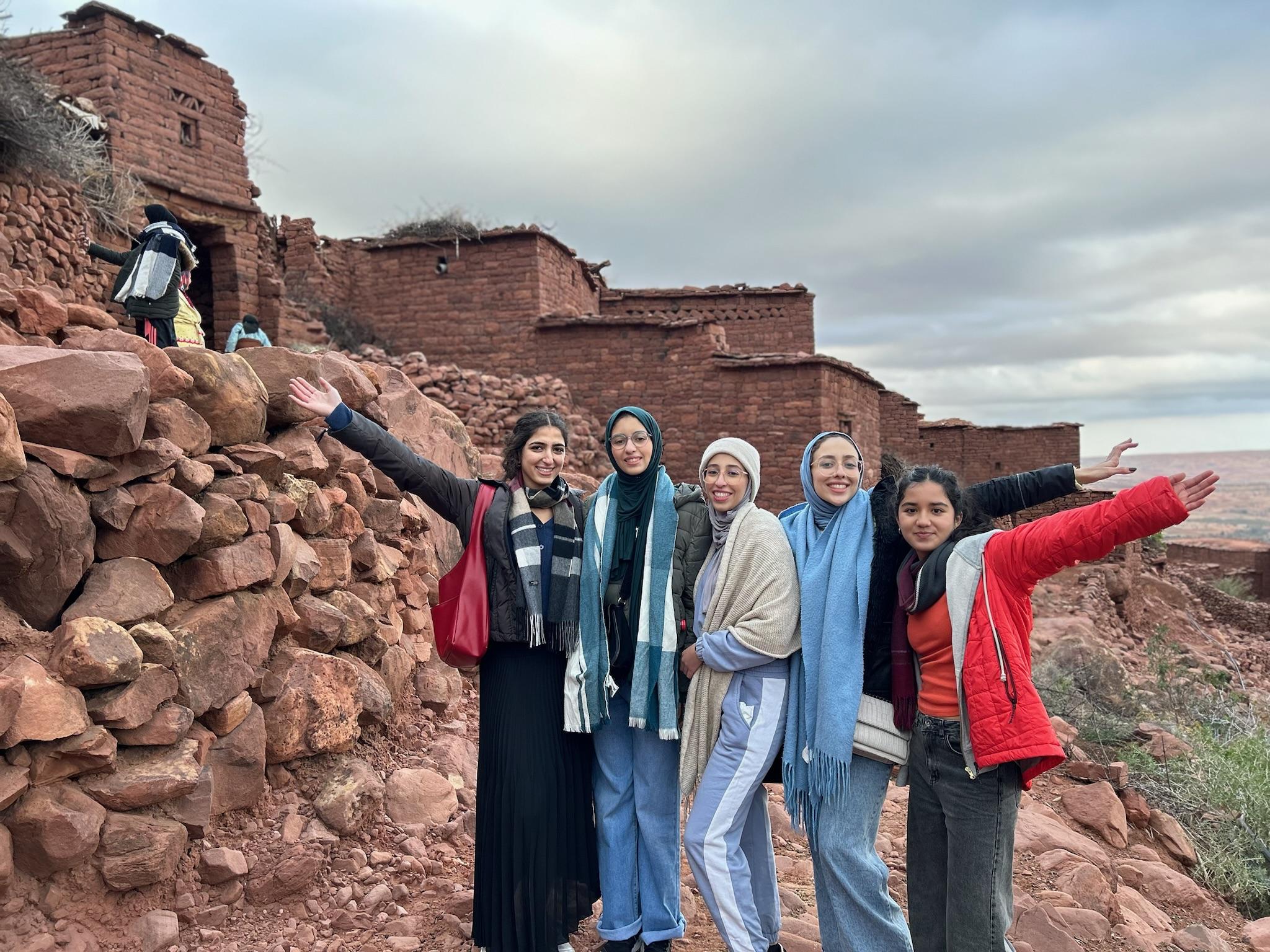
In Morocco, Ahmed lived with a host family, which required navigating both cultural differences and language barriers. Although Ahmed spoke modern standard Arabic, her host mother spoke Darija – a different Arabic dialect – and was illiterate, motivating Ahmed to adapt her communication style. “It was tough in the beginning, but we figured it out. I’d practice Darija with her every day, and instead of texting, I’d send her voice messages,” Ahmed said.
Language learning became a crucial part of each student’s experience, offering deeper insight into local culture. In Mexico, Maboudian lived in a community where many residents spoke Nahuatl, an indigenous language, alongside Spanish. “I started hearing these off-the-cuff phrases at marketplaces and little shops. They became a part of my Mexico-specific vocabulary, which really helped me hold a conversation,” Maboudian said.
For Ahmed, Arabic was the primary focus of her program. Each day included a four-hour Arabic class, taught entirely without English. The coursework aligned closely with the interests she’d pursue at Stanford. “I’m really interested in the literary and artistic history of Arab regions, and this class resonated with that; we’d read complex poetry and political documents that are hard to articulate even in English,” Ahmed said.
Beyond the classroom, students experienced history and art woven into daily life. “I took Introduction to the History of Art, and we studied art during the French Renaissance,” Ryan said. “Paris is one of the few places where you can learn about a famous artwork and walk to a museum to see it.”
As the students settled into daily life abroad, they fully immersed themselves in their cities. “I’d walk around Paris for hours,” Ryan said. “I would find myself wandering into the most beautiful churches, or somehow ending up at the Seine and having a view of the Eiffel Tower.”
“Cholula has this incredible, massive artisan market, and it runs all week,” Maboudian said. “We’d go together and get gifts for our families, and we’d learn how to bargain. It was magical.” Another defining element of studying abroad was the community built among fellow students. “My classmates in Mexico came from different parts of the world. We had different life experiences, academic interests, and ethnic backgrounds,” Maboudian said. “Hearing about their experiences was eye-opening, and they're some of my close friends now.”
Whenever homesickness resurfaced, the students relied on their newfound friendships for support. “When it got hard to stay motivated, reaching out to my cohort helped a lot; we leaned on each other,” Ahmed said. “By springtime, my spirits were a lot higher. I even felt like I wasn’t ready to leave.”
As their programs came to an end, the students reflected on the lasting impact of their experiences. “I call Morocco my second home,” Ahmed said. “I love the culture and the food, and I want to keep practicing the local dialect. I’m sure I’ll come back.” Beyond language acquisition, traveling abroad offered valuable life lessons shaped by local perspectives. “A lot of the Moroccans I’d meet were well-versed in global politics and cultures because they spoke so many languages,” Ahmed said. “I’ve learned not to keep myself in a bubble – to learn about new countries and learn new dialects.”
“By meeting so many different people in Mexico, I began thinking about the layers we have to our identity,” Maboudian said. “In a politically fraught time like today, we have to realize how these backgrounds are incredibly sacred.”
Ultimately, each student encourages peers to consider studying abroad. “There’s incredible value in spending time in another country,” Ahmed said. “Don’t be afraid to go abroad. You learn the most about yourself when you’re away from home.”
“I will never forget the months I spent in France. It was such an incredible, unique way to begin my college experience,” Ryan said. “If you’re considering study abroad, do it – you’re going to look back on it and see some of the coolest times of your life.”
Copyright 2026, Lamorinda Weekly