
Historical interpretive banners liven up the bandshell in Moraga Commons Park
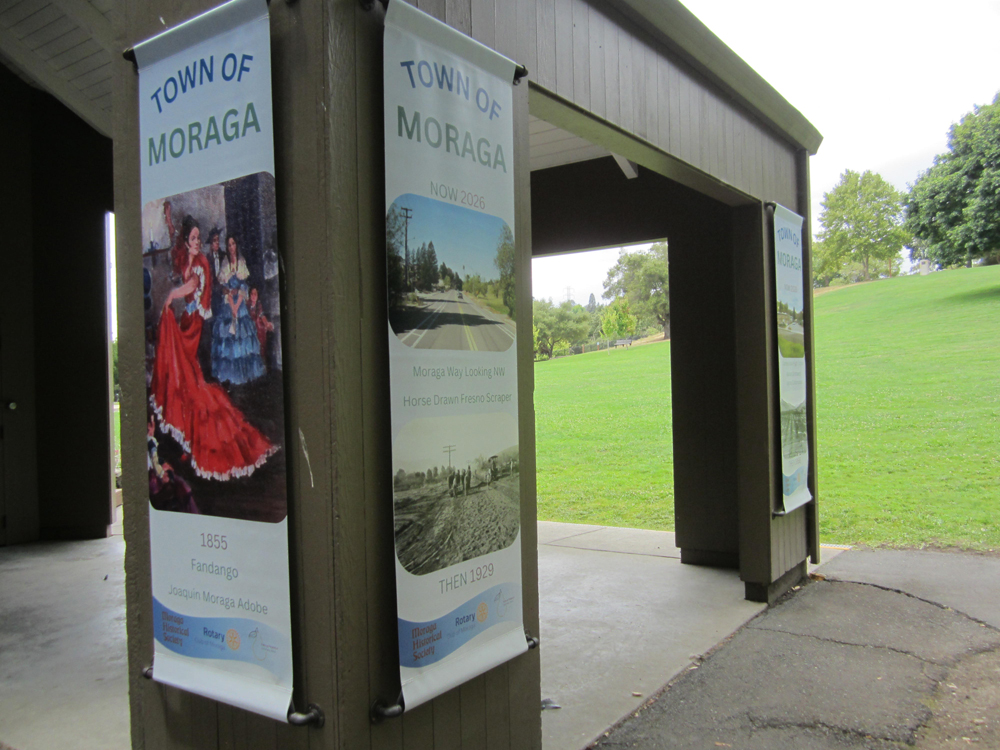
A new decorative feature to Moraga Commons Park is an installation of five historical interpretative banners hanging against some prominent columns of the bandshell. The display was made public just in time for the Fourth of July party in the park.
The Town Council approved the placement for a period of up to three years, and according to a May 13 staff report by Parks and Recreation Director Mackenzie Brady, “Through collaboration between the Rotary Club of Moraga, the Art in Public Spaces Committee (APSC), the Moraga Historical Society (MHS), and staff, the concept evolved from a single mural into a series of five historical banners. The Moraga Historical Society played a key role in identifying and sourcing appropriate archival images for the project.”
The installation includes four “then and now” banners that feature archival photos (some dating back nearly 100 years), along with contemporary images of the same locations. Included in the installation are a 1929 photo of Moraga Way (looking toward Orinda), a 1956 walnut orchard photo (now Campolindo High School), a 1935 photo of Saint Mary’s College (with its train station), and a 1935 photo of the Camino Ricardo/Moraga Way intersection (looking toward Moraga Country Club). The last banner is a colorful image of an 1855 painting from a Fandango held at the Joaquin Moraga Adobe.
Brady’s report noted that the complete project cost of $766 was funded by the Moraga Rotary Club.
The idea first began with last year’s Rotary Club President John Panetta. “I have walked my dog around the bandshell for years. It occurred to me last year that there was a large swath of flat brown space that could be livened up a bit. I first thought of a mural of the Moraga family. Then I began looking through a book on the story of Moraga with photos, so I then began to think about displaying the photos somehow. I met with Teresa Onoda, Holly Hartz, Susan Sperry, and Mackenzie Brady about the project.”
Panetta added, “From that meeting, the thought moved from mural to banners with photos. I brought up the concept of a ‘past and present’ banner which was agreed to by all.” MHS Digital Assets Coordinator John Kaiser and photographer Wilfred Galila also got involved.
APSC member Teresa Onoda said, “Art in Public Spaces served as the liaison, helping guide the project through each step and turning John’s idea into a reality. What I have come to appreciate is that in Moraga, many of our best ideas begin with one person. They then grow into community efforts, embraced by neighbors who roll up their sleeves, contribute their talents, and work together to bring a shared vision to life.”
APSC Chair Holly Hartz worked with Onoda and Brady to design the banners using the old and new photos provided by the Historical Society and Galila, and MHS President Susan Sperry orchestrated the acquisition of the historic photos and got Kaiser on board, who is in the process of digitizing the MHS physical archives and making them available online through their website.
When Panetta and Onoda showed up at the History Center with Sperry, Kaiser used his laptop to connect to moragahistory.org in order to view photo possibilities. “We eventually settled on a dozen photos that they really liked. I suggested that they approach Wilfred about figuring out and taking the 'after' photos. What was special about this project was how everybody collaborated to come up with something that is accurate and good.”
MHS member Galila recalled some difficulties with getting the perfect “after” photos. “The oldest photograph for the banner project was made in 1929. A lot has changed in Moraga since then. The terrain of the town has significantly evolved, apart from the surrounding hills and Saint Mary’s College that served as my guideposts as to where the historical photographs were taken. For instance, the historical photo of a muddy dirt road that was thought to be of Moraga Road facing towards Lafayette, was actually that of Moraga Way facing towards Orinda."
Galila added, “I had the pleasure of photographing the current versions of the historical photos for the banners while learning more about Moraga’s rich history and gaining a deeper appreciation and sense of pride for the town where I live.”
Copyright 2026, Lamorinda Weekly