
Terraces tensions resurface during City Council parcel consolidation hearing
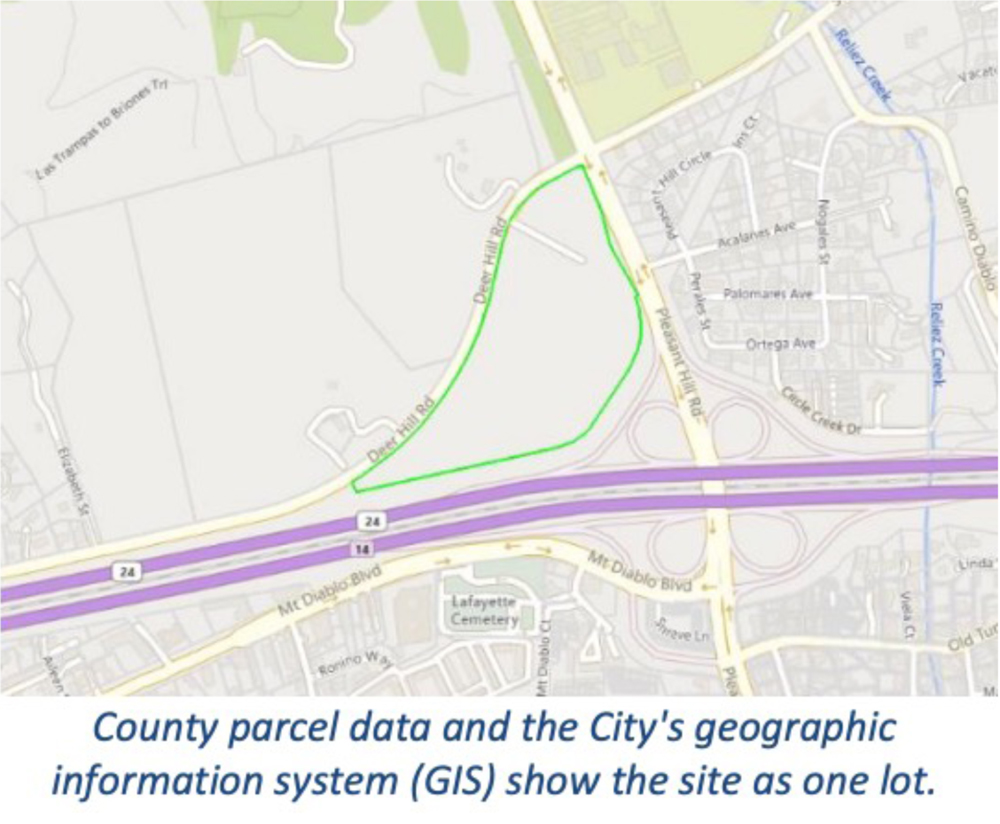
At a public hearing during the June 22 Lafayette City Council meeting, city planners and the attorney for O’Brien Land Company stated their case for the consolidation of 10 parcels into one parcel to allow the construction of the Terraces of Lafayette project – a 315-unit moderate-income level apartment project at 3233 Deer Hill Road, which was originally applied for in 2011.
According to a staff report presented by Contract Planner Jean Eisberg, the hearing was scheduled following an April 30 email by City Council Member Susan Candell who appealed the Planning Commission’s April 20 decision to approve the Minor Subdivision application, stating, “I believe that this project and decision is of such profound importance to the city and people of Lafayette, that it should be heard by the full, elected City Council.”
“When the original application was submitted and approved,” Eisberg wrote in the report, “parties understood there to be a single fee-simple parcel with one assessor’s parcel number, that did not require consolidation. Subsequent information finds the project site to consist of ten parcels of land that requires consolidation prior to construction.”
The hearing brought some of the tension relating to the project back to the surface as supporters and opponents of the project weighed in about traffic and fire safety versus the need to add more affordable housing to the area.
Save Lafayette founder Michael Griffiths voiced concerns for residents of Lafayette in what will become an even more densely populated area with 315 additional dwellings, who may not be able to evacuate quickly enough in the event of a fire. Griffiths brought up the Paradise fire, which he said led to 84 deaths and PG&E’s declaration of bankruptcy, and the Lafayette Tennis Club fire from a few years ago that caused a significant backup of traffic.
“When there’s a lot that’s less than a mile long, it doesn’t take long for a wildfire to sweep across the land,” Griffith said. He added that software calculations indicated that if evacuating cars took 10 seconds each, it would take some 40 minutes for cars to evacuate.
Supporters of the project, like Jeremy Levine from Inclusive Lafayette, pushed to get the approval done so the project can move forward. “I really look forward to seeing 315 families, or old people downsizing, or young people looking for a job moving into that project when it's built,” Levine said. “I think it's going to be a really amazing thing for our community.”
Collin Regal questioned the legality of the project and pushed for the council to continue the hearing, as there was debate over whether or not the original permits were still intact and valid.
Eisberg stated that there are several permits that are approved but not issued including the mass grading permit, the retaining walls and the vertical building permit that allows for the construction of the 14 residential buildings, a club house and more.
Council Member Candell asked for specificity on the terms and conditions of approvals, permits and deliverables that demonstrate the work in progress.
“What can we point to that helps us define what the line (that indicates that a permit is still valid because there is work in progress) is for us? … What is there that satisfies that for us legally?” Candell asked.
Brian Winters, legal counsel for the applicant, argued that it was not the time to relitigate the validity or risks of the project. “This project remains protected by the Housing Accountability Act in the same way that it was in 2020 under which the project can only be disapproved if the city can make specific adverse impact public health and safety findings supported by a preponderance of the evidence in the record,” Winters said.
The appeal ultimately passed with 3 council members voting in favor, Candell voting against and Council Member Stella Wotherspoon not present.
Copyright 2026, Lamorinda Weekly