
Lamorinda councils hear about transportation projects, local legislation during annual tri-city meeting
Members of the Lafayette, Moraga and Orinda city and town councils heard updates on current and pending legislation, as well as on proposed transportation projects and funding issues from representatives of Bay Area Rapid Transit (BART), the Contra Costa Transportation Authority (CCTA), and Townsend Public Affairs during a July 16 joint meeting at Saint Mary’s College.
Townsend Public Affairs Vice President and Chief Strategy Officer Casey Elliott updated the council members on the California State Budget, as well as local legislative efforts including Wildfire Preparedness Bills AB 2513, which would allow Lamorinda agencies to apply for regional fire mitigation landscape grants, and AB 2517, which would establish a process to review fire hazard severity zone designations every five years.
Elliott also discussed e-bike legislation (AB 1569 and AB 2346) which would focus on increasing e-bike safety through standardized training programs and local control over speed restrictions.
“The state of California really, really messed up when they set a maximum speed for e-bikes at 28 miles per hour, without any licensing, education or insurance requirements, as opposed to Europe that sets it at 15 miles an hour,” he said. “And now we have a real mess on our hands, and I hope we can progress where we need to progress.”
BART Chief Financial Officer Joe Beach gave an update on expenditures, which have been flat since 2019, according to the Metropolitan Transportation Commission. Customer satisfaction numbers have gone from 70% in 2019 to 90% today, and fare revenue that previously supported two-thirds of BARTs operating costs is more than $400 million lower than projected back in FY19. New fare gates have been helping increase revenue, and ridership has tripled since fiscal year 2021, but emergency funding that sustained and improved service is nearly depleted, he said.
While Beach said BART has made efforts to close the gap through hiring freezes, targeted operating cuts, running shorter trains, and more, operating expenses remain high and BART is hoping Senate Bill 63 passes in November. SB 63 is a multi-county sales tax measure that would raise roughly $980 million annually for public transit operations, including BART.
“If the measure passes,” Beach said, “then there’s a phase two accountability that would require BART and the other operators to identify additional long-term structural cost-saving measures and develop a regional strategy to maximize real property assets.”
If the measure does not pass, Beach said BART will need to cut service times, cut jobs, increase fares by 30%, and close some stations, starting as early as January 2027.
When asked why closing stations were being considered, when net savings for closing a station is limited, Beach said that BART needs to focus on actions within its control.
One council member noted that residents within Lamorinda “rely pretty heavily on both Lafayette and Orinda BART stations, and we want both of those stations to remain active and open.”
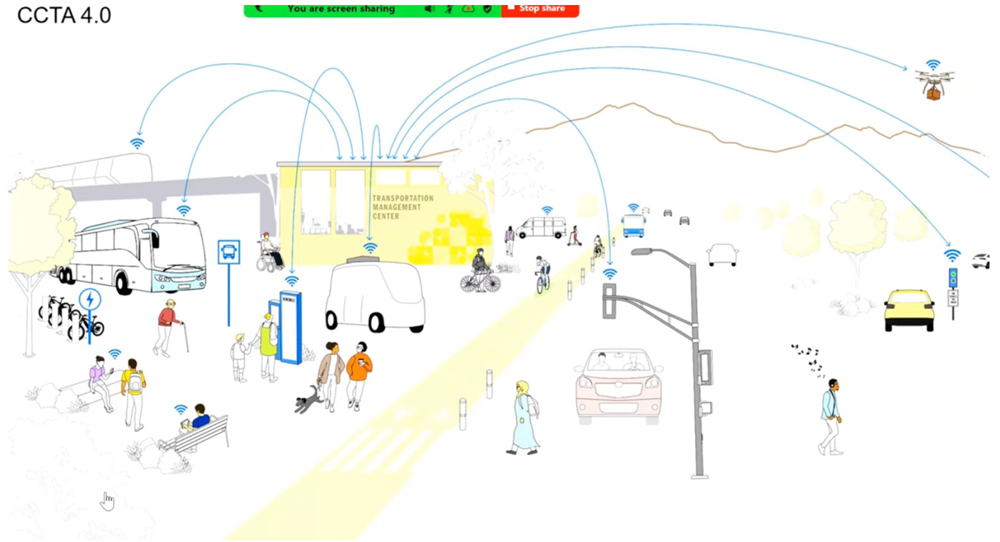
Following Beach’s presentation, CCTA Executive Director Tim Haile discussed a County-wide Emergency Evacuation Study and a roughly $5 million Smart Traffic Signals project.
According to Haile, CCTA is upgrading 365 traffic signals in Contra Costa County, including 56 signalized intersections in Lamorinda. “We want Lamorinda to be a model for what this connected system can look like,” Haile said.
“The system is now evolving with technology, so now what we have is a lot of different systems – a highway system, a street system a signal system, emergency response systems, electric vehicle systems, bike share systems – and it will be important to manage all these different systems,” Haile said. “The County-wide Smart Signals system is laying the foundation for that.” The project should start construction in spring of next year, be completed in summer of next year and operational by the fall.
The final presentation made to council members involved both the Moraga Public Works Director/City Engineer Nate Levine and Orinda City Engineer Siva Natarajan. The project’s starting step began after receiving a $508,000 SS4A grant procured by Moraga’s former Public Works Director/City Engineer Shawn Knapp, with the goal to add a 10- to 12-foot-wide trail that can be converted to emergency vehicle access during an evacuation. The grant was awarded in December 2025, and the grant agreement is expected by the end of the year, with a draft and final report delivered in late 2027 or early 2028.
To view the entire meeting, visit https://www.youtube.com/watch?v=rxOspGYxx2g
Copyright 2026, Lamorinda Weekly