
Acalanes DAR marks America 250 with Lafayette Commemoration and Living History Program
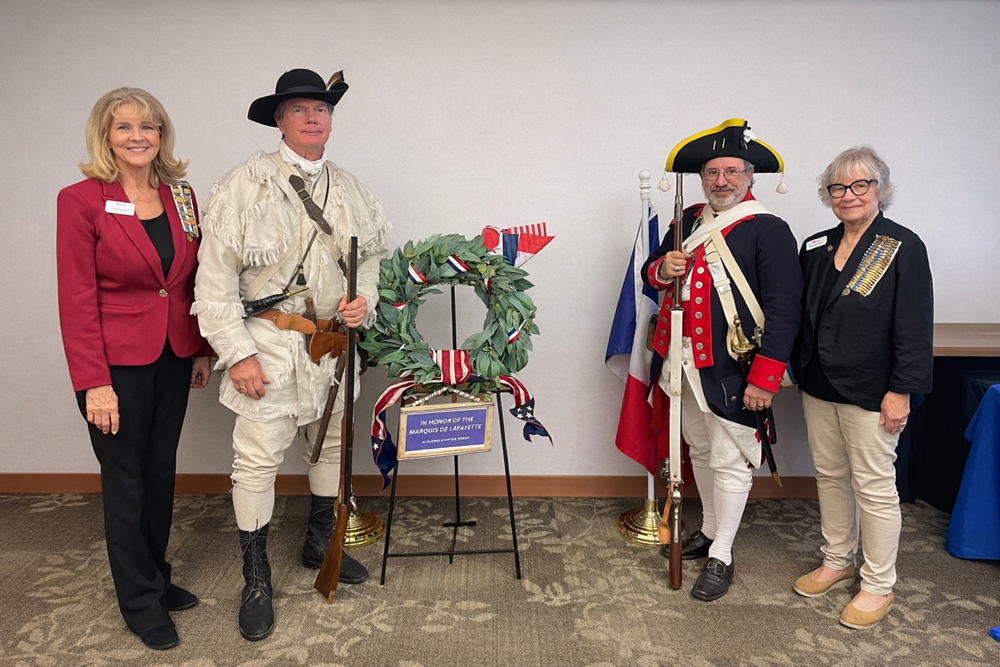
The Acalanes Chapter of the National Society Daughters of the American Revolution (NSDAR) brought Revolutionary history to life in early April with a dynamic program and public commemoration honoring General Gilbert du Motier, Marquis de Lafayette—all part of the chapter’s ongoing participation in the nationwide America 250 initiative.
The day began with a chapter meeting featuring a living history presentation by Russ Kaiser of Haslet’s Delaware Regiment and Steve Bowman. Together, the two reenactors offered a vivid comparison of Continental Army and militia soldiers during the Revolutionary War.
Kaiser, also a member of the Sons of the American Revolution, appeared in the full uniform of a Continental soldier in Haslet’s Delaware Regiment. He explained that much of the equipment used by American troops—including uniforms and weapons—was supplied by France in support of the Revolution. His wool uniform, worn in multiple layers over linen undergarments, illustrated the harsh realities faced by soldiers marching in summer heat and humidity. He described the extensive gear carried by a typical Continental soldier, including a canteen, ammunition, musket, and a shoulder bag known as a haversack, along with a pack containing food, bedding, and sometimes tenting materials.
In contrast, Bowman portrayed a rifleman serving under General Daniel Morgan, wearing lighter, homespun clothing in natural beige and brown tones that provided both comfort and camouflage. His long rifle, made in the American colonies, demonstrated superior accuracy compared to the standard musket. He also displayed a smaller personal pouch used by riflemen—commonly called a “possibles bag”—which carried essential tools and supplies.
The presenters demonstrated the loading and firing of both weapons, noting that a musket could fire approximately four shots in the time it took to load and fire a single rifle. However, riflemen often operated from behind trees or cover, targeting British officers whose distinctive uniforms made them visible on the battlefield, while musket-bearing troops fired in coordinated lines toward advancing enemy formations.
Participants formed a short procession to the nearby Lafayette statue, led by the Young American Patriots Fife and Drum Corps. Parade participants—many carrying and waving small American and French flags—accompanied the march, adding to the celebratory and patriotic atmosphere.
The ceremony concluded with musical selections by the Fife and Drum Corps, including “La Marseillaise,” “The Star-Spangled Banner,” and “Yankee Doodle,” celebrating the historic alliance between France and the United States.
The Acalanes Chapter of the National Society Daughters of the American Revolution (NSDAR) brought Revolutionary history to life in early April with a dynamic program and public commemoration honoring General Gilbert du Motier, Marquis de Lafayette—all part of the chapter’s ongoing participation in the nationwide America 250 initiative.
The day began with a chapter meeting featuring a living history presentation by Russ Kaiser of Haslet’s Delaware Regiment and Steve Bowman. Together, the two reenactors offered a vivid comparison of Continental Army and militia soldiers during the Revolutionary War.
Kaiser, also a member of the Sons of the American Revolution, appeared in the full uniform of a Continental soldier in Haslet’s Delaware Regiment. He explained that much of the equipment used by American troops—including uniforms and weapons—was supplied by France in support of the Revolution. His wool uniform, worn in multiple layers over linen undergarments, illustrated the harsh realities faced by soldiers marching in summer heat and humidity. He described the extensive gear carried by a typical Continental soldier, including a canteen, ammunition, musket, and a shoulder bag known as a haversack, along with a pack containing food, bedding, and sometimes tenting materials.
In contrast, Bowman portrayed a rifleman serving under General Daniel Morgan, wearing lighter, homespun clothing in natural beige and brown tones that provided both comfort and camouflage. His long rifle, made in the American colonies, demonstrated superior accuracy compared to the standard musket. He also displayed a smaller personal pouch used by riflemen—commonly called a “possibles bag”—which carried essential tools and supplies.
The presenters demonstrated the loading and firing of both weapons, noting that a musket could fire approximately four shots in the time it took to load and fire a single rifle. However, riflemen often operated from behind trees or cover, targeting British officers whose distinctive uniforms made them visible on the battlefield, while musket-bearing troops fired in coordinated lines toward advancing enemy formations.
Participants formed a short procession to the nearby Lafayette statue, led by the Young American Patriots Fife and Drum Corps. Parade participants—many carrying and waving small American and French flags—accompanied the march, adding to the celebratory and patriotic atmosphere.
The ceremony concluded with musical selections by the Fife and Drum Corps, including “La Marseillaise,” “The Star-Spangled Banner,” and “Yankee Doodle,” celebrating the historic alliance between France and the United States.
Copyright 2026, Lamorinda Weekly