
Author discusses how the Declaration of Independence became ‘news’
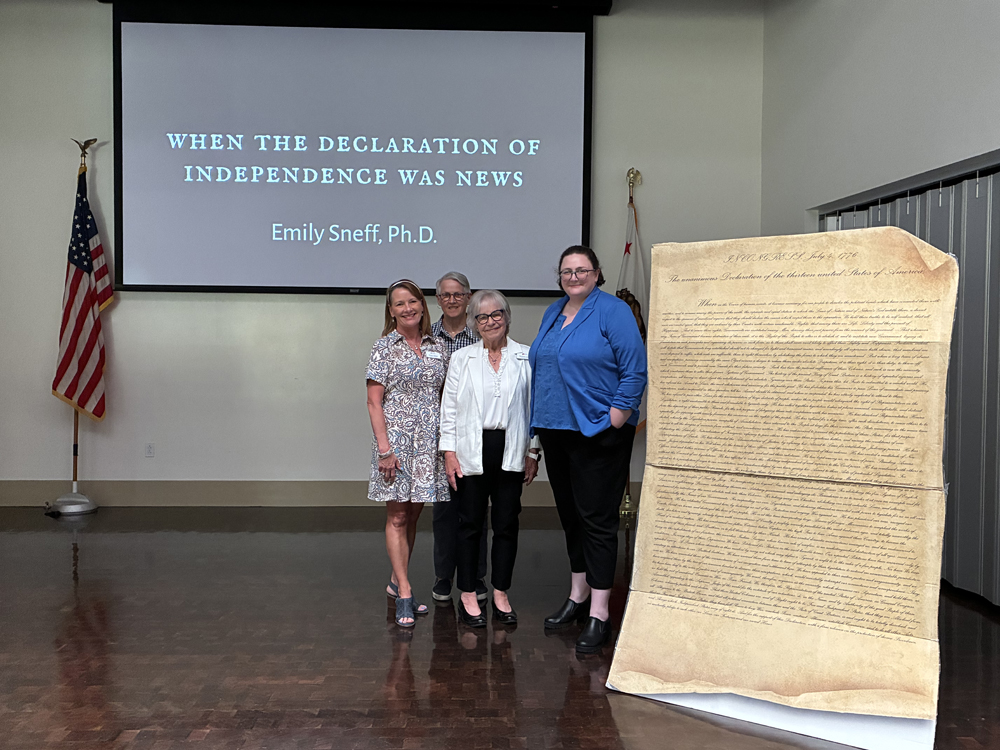
More than 100 guests gathered at the Lafayette Library and Learning Center on Aug. 6 for a presentation by historian Emily Sneff, author of “When the Declaration of Independence Was News.” The sold-out program explored a side of the Declaration of Independence that many Americans have probably never considered: once Congress adopted it, how did the news actually reach the public?
The program was presented by the Acalanes Chapter, National Society Daughters of the American Revolution, in partnership with the Lafayette Historical Society and the Commonwealth Club of California, as part of the chapter’s commemoration of the 250th anniversary of American independence.
Drawing from the research in her book, Sneff described how Philadelphia printer John Dunlap produced the first printed copies of the Declaration and how those broadsides began spreading the news of independence. The first printing was produced during the night of July 4, with copies delivered to Congress on July 5 and then distributed to state assemblies, conventions, committees of safety and military commanders.
For audience member Ramona Davis, the mechanics of spreading the news were among the evening’s most fascinating revelations.
“I had never really thought about how they got the Declaration out to the public—there was no internet, radio or television,” Davis said. “It was amazing how quickly the news spread despite that. I was also fascinated by the many translations and how the Declaration was used as a model by others, giving its words even greater reach and strength.”
One story particularly intrigued audience member Mary Jane Hofmeister. Sneff told of Jonas Phillips, a German-born Jewish merchant and Patriot living in Philadelphia, who wrote a letter in Yiddish to a relative in Amsterdam on July 28, 1776, enclosing one of the original Dunlap printings of the Declaration.
Phillips’ letter also captured the uncertainty facing those who were actually living through the events of 1776. After describing the enclosed Declaration, he wrote, “How it will end, the blessed God knows.”
Sneff’s presentation offered a reminder that the document now carefully preserved under glass at the National Archives was once something very different: breaking news – new, uncertain and consequential – as people across America and beyond tried to understand what independence might mean.
Copyright 2026, Lamorinda Weekly