
Downtown Lafayette Parking Management Study presented to city council
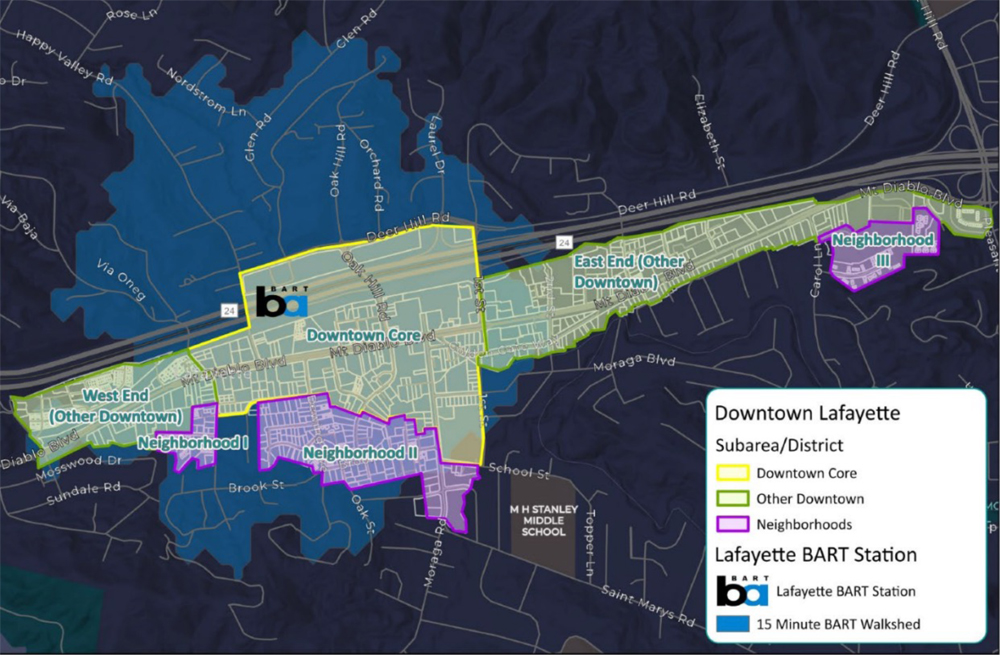
Transportation and Circulation Program Manager Patrick Golier presented the Downtown Lafayette Parking Management Study to the City Council during its April 27 meeting.
The study, funded by the Metropolitan Transportation Commission (MTC) Parking Management Planning Grant, evaluated the existing and future parking conditions in the downtown Lafayette area using county assessor data, city tax revenue data, pipeline project information, and Regional Housing Needs Allocation projections to forecast future demand under multiple policy scenarios as well as community input. The study builds on the city’s 2016 Parking Management Strategy, which focused on balancing downtown development with parking supply.
Golier presented the staff report to the council along with Siqing Yi and Ben Miller from Alta Planning + Design. According to the staff report, the study found that downtown Lafayette’s parking challenges are primarily related to location, user behavior, and system coordination rather than a systemwide shortage of spaces.
“Peak occupancy levels remain well below thresholds that would indicate a systemwide shortage,” Golier stated in the report. “However, parking demand is unevenly distributed, and the system is fragmented across multiple public and private operators, regulations, and enforcement practices. As a result, users often experience confusion, unnecessary circling, and perceived shortages in high demand areas—despite the presence of available parking elsewhere.”
The study found that peak occupancy of the nearly 5,000 publicly accessible parking spaces has on average approximately 52% occupancy on weekdays and 55% on weekends, leaving over 1,100 parking spaces unused during peak parking periods. Staff recommended share-use agreements, parking maps, real-time monitoring, and better wayfinding. Staff also noted the uneven demand, with some blocks overburdened with parking – such as Plaza Center and Diablo Foods – while others have minimal use.
Unmet employee parking needs and safety challenges were a continuing concern. Currently, there is limited secure parking for employees and many employees must take long walks through poorly lit areas for parking spots. The plan to remedy this involved coordination, not new parking supply, by expanding permit programs, improving lighting and enhancing unified management for pedestrian safety and consistent parking policy enforcement.
Fragmented management was another concern. Multiple disconnected entities manage parking, causing inconsistencies in policies and unclear oversight. This has caused unclear pricing, time limits, and regulations for drivers. Like the employee needs problem, the proposed solution involves unified management to improve accountability and transparency, in addition to creating standardized policies.
The top 10 actions recommended for the city to take focused on managing downtown parking as a coordinated system, preserving short-term downtown parking for customers and visitors, formalizing expansion of employee parking options, simplifying parking regulations, improving signage and wayfinding, enhancing public facing information, pursuing shared parking agreements, using performance metrics to guide changes over time, and integrating parking management with walking/biking projects. The consultants intentionally designed these actions to be practical and achievable in the near term. The goal is to have systems and networks in place so people park once and walk from one place to another.
According to the staff report, Phase 1 implementation activities are expected to require approximately $80,000 to $160,000 in consultant services over the next several years, depending on the level of consultant support for data collection and wayfinding planning. By July 1, 2027, Golier said he would like to have parking inventory complete, set up a more robust employee parking permit program, identify opportunities for a shared parking program and have a process in place for that, and start to think about wayfinding and branding.
Staff was directed to return to the city council with a detailed implementation work program and any associated budget requests as part of a future funding cycle.
To view the full staff report, visit: https://lafayette.granicus.com/MetaViewer.php?view_id=&event_id=1443&meta_id=208429
Copyright 2026, Lamorinda Weekly