
SMC holds Active Shooter Response Workshop
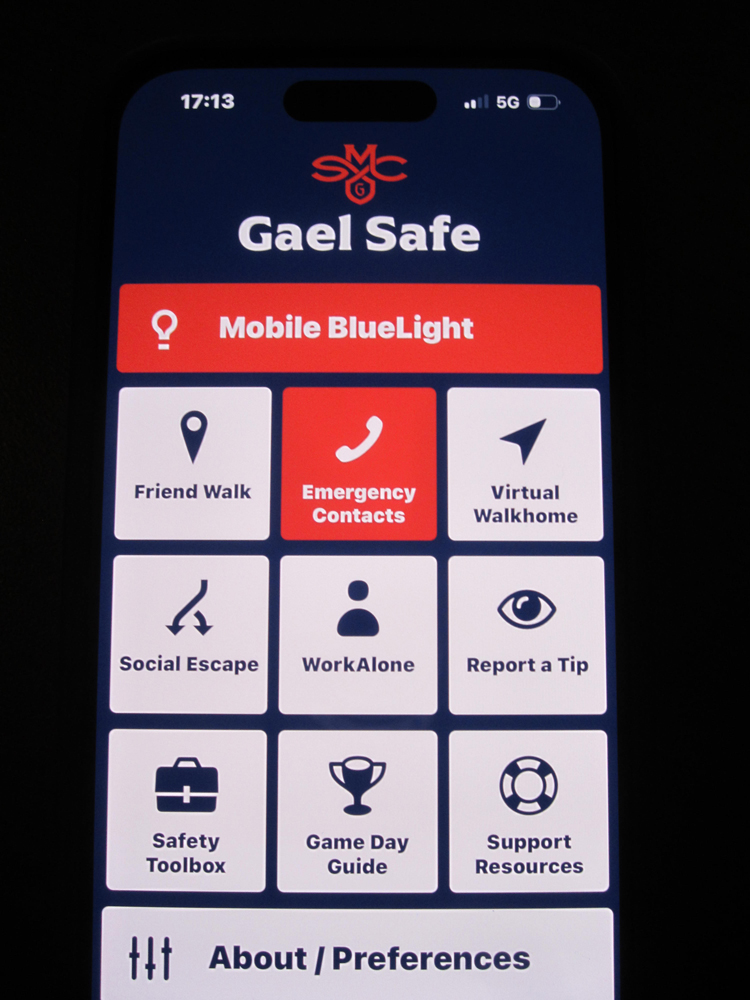
Saint Mary’s College held an Active Shooter Response Workshop on April 9 and 15 for students and staff in order to explain key concepts to help protect both individuals and the campus. The workshop also offered guidance on how to respond effectively.
Campus Safety & Transportation Executive Director Nathan Johnson, Ed.D. took attendees through various objectives such as providing background on active incidents, discussing general strategies for surviving an active incident based on best practices, encouraging the need to pre-plan, and identifying available resources and capabilities. He stressed that the recommendations are general and might not apply to every situation.
Johnson noted that, “The FBI designated 229 active shooter incidents from 2019 to 2023. This represents an 89% increase in active shooter incidents (121) from the previous five-year period (2014-2018). The 229 active shooter incidents from 2019 to 2023 occurred in 44 states and the District of Columbia.” The period between 2024 to 2025 showed the first decline in recent years by 50%.
General statistics for active shooter incidents in the United States between 2000 to 2013 were 510 incidents with a total of 3,657 casualties. Businesses had 220 incidents while houses of worship had 16. The most common weapons used were handguns (465), rifles (176), and shotguns (60).
“The perpetrators of mass shootings are often incorrectly portrayed as mentally unhinged individuals who simply ‘snap’ and engage in a killing rampage,” explained Johnson. “The reality is that the majority of mass public shooters are individuals who would not be classified as either clinically or legally insane at the time of their crime.”
Johnson added, “The perpetrators are more likely to be angry, vengeful individuals who seek retribution for a perceived harm done by some person, group, or institution. Moreover, mass public shooting incidents are generally premeditated and often planned well in advance of their commission.”
According to Johnson, “Run (if you can), Hide (if you need to), and Fight (if you must).” These are key elements to surviving an active shooter incident. “Run: Get out, even if others insist on staying; help others if possible; leave belongings behind; and once out, call 911. Hide: If you can’t get out, find a place to hide; barricade or lock doors; hide behind large objects; be quiet and silence your phone; and if necessary, play dead. Fight: Attempt to incapacitate the shooter; act with aggression; improvise weapons; and commit to your actions.” Most importantly, “don’t be a deer in headlights – think and act.”
If, during an incident, phone contact with the police is made, be prepared to provide the location; a description of the suspect/suspects; any special considerations; type of weapon (if known); and stay on the phone with it set to vibrate. In the event of possible explosives, don’t move or touch anything, and don’t use a mobile phone near the device. They emit electromagnetic waves and radio frequencies that can theoretically trigger detonators or ignite surrounding explosive vapors.
Pre-planning for an active shooter situation is one way to get ahead of an otherwise potentially chaotic scenario. Johnson recommends locating safe spaces within work areas; knowing which entrances and exits lock; noting movable furniture to block doorways; always carry a mobile phone; be able to notify police of location and status; and use anything at hand that could be a weapon such as a heavy stapler, letter opener, chairs, etc.
After an incident, don’t be afraid to seek counseling. Post traumatic symptoms may occur in the form of changes in behavior, change in diet, and sleep disorders (lack of/nightmares).
“If you remember as much of this advice as possible,” stated Johnson, “it will greatly diminish your risks.”
Copyright 2026, Lamorinda Weekly