
Crossing Guard Controversy
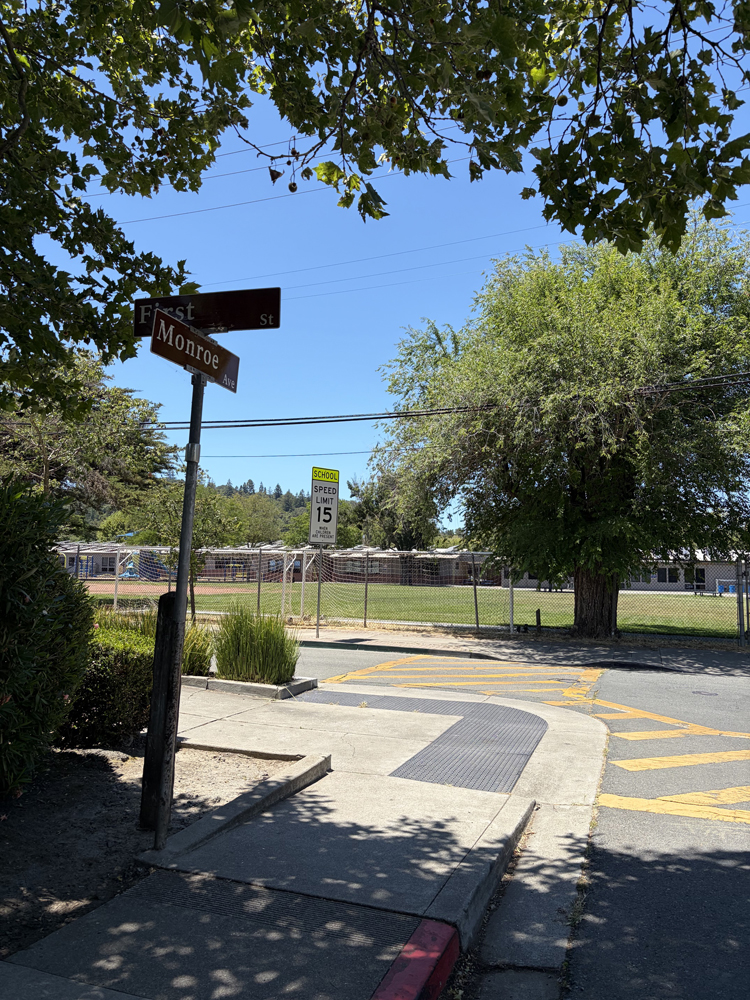
When 11-year-old Kai walks to school from Second Street, which is densely populated with renters, she carefully crosses Mt. Diablo Boulevard on her own, before later crossing a few side streets and eventually crossing by Monroe and First Street, where she gets to see the one and only crossing guard on her way to Lafayette Elementary School.
“I always feel like I have to be really, really careful because a lot of drivers aren’t paying attention,” Kai says. “I kind of wish there were more crossing guards.”
In the coming academic year, Kai’s route will get longer as she will be a sixth-grader at Stanley Middle School.
Everett Redman, age 14, was in fifth grade the year that crossing guard Ashley Dias died while shielding students from a car. Redman made the daily journey to LES to meet his younger sister from Stanley Middle School for the past three years. “I find the crossing guards to be fairly helpful,” Redman says. “Not a lot of people pay attention. Kids are on their phones. Drivers aren’t always paying attention. If there isn’t someone there to stop and remind kids to pause, there could be another accident.”
For the last several years, the Lafayette School District and the City of Lafayette have partnered and split the cost to ensure that students had a total of 11 crossing guards at some of the critical crossing points on their kids' journeys to school. LAFSD Superintendent Brent Stephens said the district was forced to make tough choices to reduce its budget to $1.8 million, bringing the three-year total of budget cuts to just shy of $6 million. “This year, through a series of public deliberations, the governing board decided it needed to reduce its own expenditures on crossing guards to zero, along with a number of other cuts to LAFSD staff (including the PE Specialist, the Early Intervention administrator, library aide time and more),” Stephens said.
This initially brought the total of crossing guards down from 11 to 7.
At the June 22 Lafayette City Council meeting, the Council approved the reinstatement of two crossing guard positions – one at First Street and Monroe Street and another at Springhill Road and Reliez, bringing the total number of positions back up to 9 for one year with terms and conditions. The cost for those two positions is $42,000.
Council Member Susan Candell agreed that they should add the two crossing guards back in and “continue to think thoughtfully about how to phase them out at some point, if we can, if there's other solutions that we can find, where we won't need all these crossing guards forever.”
Vice Mayor John McCormick echoed the same sentiments. “I think we really [have] to look at keeping this thing as lean as we possibly can,” McCormick said. “Prioritizing safety, but also I agree, ... we don't want to be funding a 30-year thing where it's just the same amount indexed for inflation for the next 30 years; it's not really solving the problem.”
Jenny McCarthy-Redman, the parent of a rising middle schooler and high schooler in Lafayette and a frequent volunteer at LES, isn’t quite sure that the city has its priorities right. “I remember when the city launched Vision Zero after Ashley Dias was tragically killed,” McCarthy-Redman says. “It’s terrible that we lost a human life that day, but we might’ve lost a student if there wasn’t a crossing guard there.”
To McCarthy-Redman the cuts are both shortsighted and perhaps a bit-off-brand for a city that claims to love its schools and its walkability factor.
“We need more, not fewer guards. If I had a wand, I’d add one on Moraga Road and Moraga Way – where a pedestrian was killed a few years ago – along with other traffic calming measures. I’d also add one by Pleasant Hill Road for the high schoolers going to Acalanes,” McCarthy-Redman says. “I think the reason people’s property value is what it is, is largely due to the appeal of the schools. We need to have safe walkable, bikeable transit in our city.”
Superintendent Stephens called the city a strong partner and commended them for designing and implementing traffic mitigation strategies such as flashing lights, upgraded walkways and pedestrian crosswalks, which have amounted to a $2 million investment by the city.
McCarthy-Redman thinks those types of “traffic calming strategies” are important, but not a replacement for human crossing guards who are invested in not only the children’s physical safety, but also their well-being.
“For some kids, the interaction with a crossing guard, who knows their name, gives them a high five, is the best interaction they have all day,” McCarthy-Redman says.
Sarah Phillips is a second-grade teacher at Happy Valley Elementary School and the mother of two students in the Lafayette School District. Phillips’ daughters walk to school every day, which is something she’s comfortable with because of Ron, her local crossing guard.
“I would rather have some potholes in the road, than have young people and their families able to feel safe and cross the streets on their way to Lafayette Schools, so it seems like upside down priorities a little bit,” Phillips says. “The crossing guards watch out for our children and our community. When young people have the chance to be known by an adult, who greets them by name as they cross the street, means everything.”
Like McCarthy-Redman, Phillips is invested in finding a way to save the crossing guard program so that the community feels safe, walkable, bikeable and folks can enjoy a sense of belonging.
“The more people we have watching out for our children and our community, the better,” Phillips says. “If budget cuts absolutely have to be made, then I would hope we could develop a parent and community model that could allow families to help each other with getting to and from school safely.”
Copyright 2026, Lamorinda Weekly